

New Deck Interview: The Oracle of Gilgamesh
Let's get to know our new release

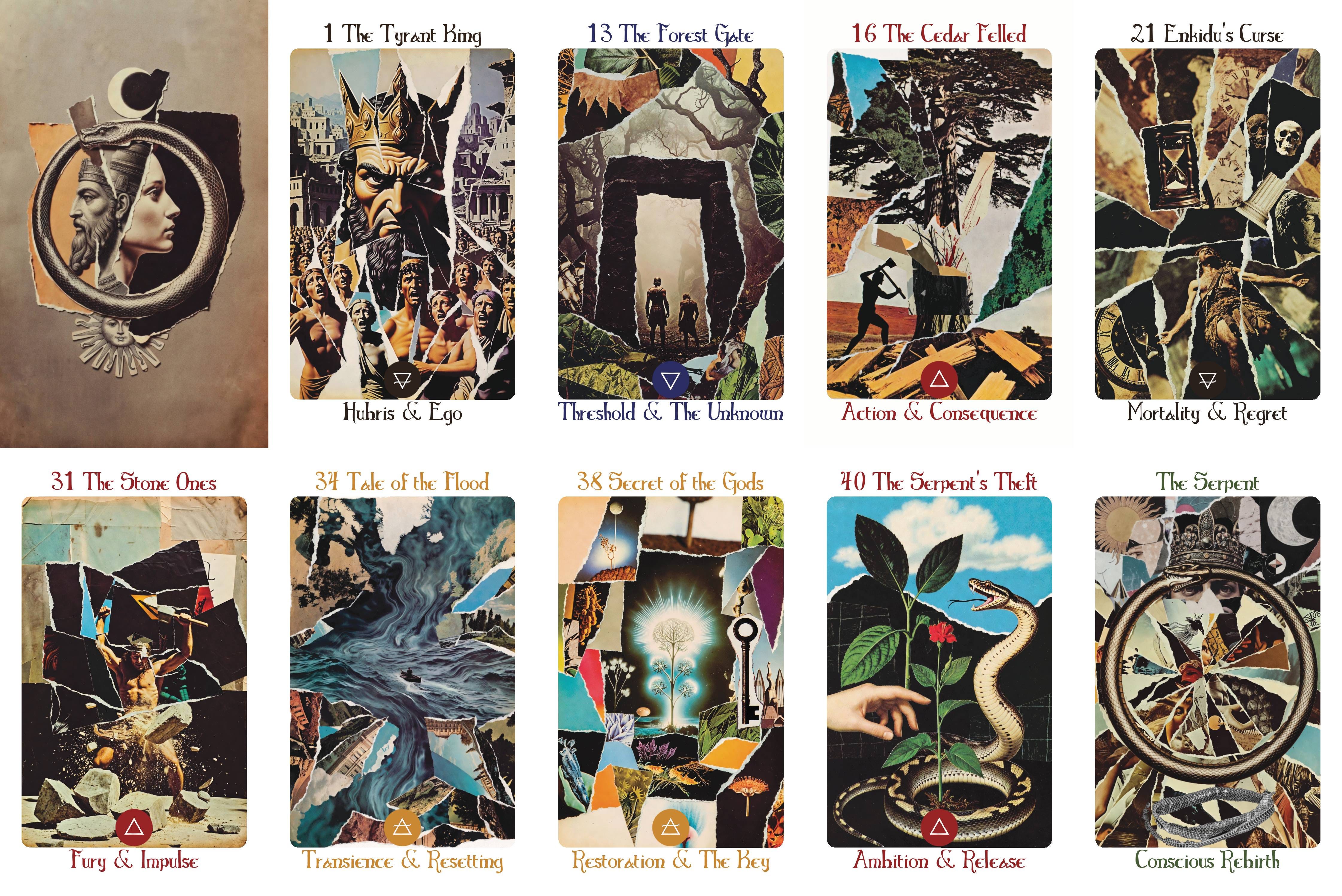
The Oracle of Gilgamesh retells the world’s oldest written story: a Mesopotamian myth rich in archetypes, in images, and in hard-won human truth. At its heart it’s the story of a tyrant king - brilliant, brutal, beloved - who loses his closest companion to death and is forced, for the first time, to reckon with his own mortality. What follows is a journey through grief, towards wisdom, towards something that might just be called enlightenment.
Our deck uses dynamic collage artwork and resonant keywords to view this ancient story through two powerful modern lenses: Jungian psychology and alchemical transformation. The result is a 54-card system - part oracular tool, part psychological map - designed to be read both as a chronological journey through the myth and as a non-linear, reflective practice. That non-linearity matters. The path towards wholeness rarely runs in a straight line.
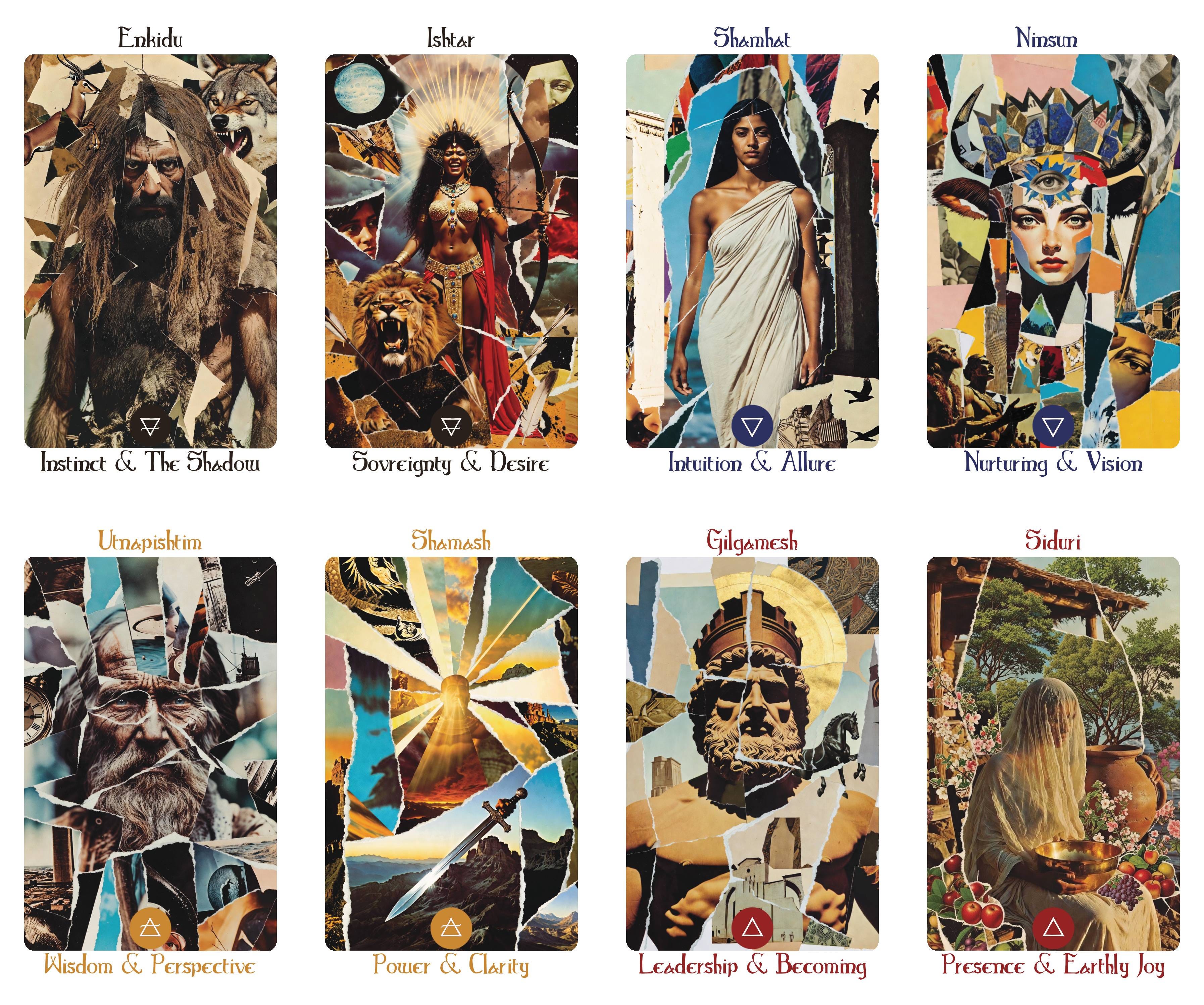
Structurally, the deck comprises four suits of 13 tarot-sized cards, each grouped around one of the four alchemical stages: Nigredo (Earth / Sensation), Albedo (Water / Feeling), Citrinitas (Air / Thinking), and Rubedo (Fire / Intuition). Within each suit, 11 numbered Event cards track the major narrative beats and psychological milestones of the Epic, while 2 un-numbered Character cards introduce the archetypal figures who embody that suit’s essential energy. On the surface, the deck shares some structural DNA with a traditional playing card deck. Its true power, though, lies in its non-linear movement — a reflection of the winding, irreducible path towards wholeness.
We’re excited. And a little nervous. And to mark the moment properly, we sat down with the deck to ask it who it is.
There’s a ritual that runs through oracle communities, quiet and consistent, like a thread through cloth: the new deck interview. Before we read with a deck, we read for the deck. We ask it who it is. What it can do. Where it will stretch us. And we listen, with the same respect you’d offer any new collaborator.
We’ve been through a lot with this deck. Months of work - researching, writing, designing, agonising, drawing cards from our prototype editions - and we’re finally at the point where it’s ready to go out into the world. Before that happens, it felt right to sit down with it properly. To stop being its authors and start being its readers. To ask it, plainly: who are you?
Six cards. Six questions. Here’s what it said.
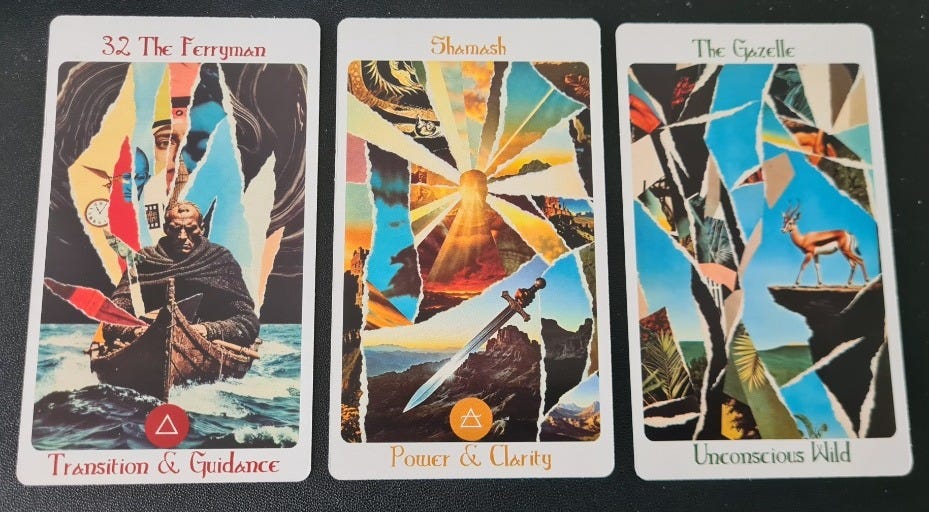
What is your core energy? 32: The Ferryman - Transition & Guidance
We honestly couldn’t have scripted a better opening. The Ferryman is a card of movement — not frantic, impulsive movement, but the purposeful kind. The crossing. The commitment to getting from one shore to the other, even when the waters are rough.
Urshanabi doesn’t flatter. He doesn’t wave Gilgamesh straight through. He demands an account. Tell me your name. Tell me what’s brought you here. And only then does the work begin. The Fire suit burns underneath this card - Rubedo, the final, effortful stage of alchemy, representing our intuition. This deck isn’t here for a casual encounter. It’s offering to take us somewhere.
Transition and Guidance as a core energy feels exactly right. Something about this deck has always felt like a threshold — a door between what we know and what we haven’t yet had the language to name.
What are your strengths? Shamash - Power & Clarity
If The Ferryman was an exciting opening, Shamash is almost unfair in how good it is. The Sun God. Patron of Gilgamesh, the All-Seeing, the one whose sword parts the mountain to let the light through. Power and Clarity.
Shamash belongs to the suit of Citrinitas, representing the element of Air and the modality of thinking - it’s the suit of the intellect at its most refined and most radiant. In the card’s imagery, the sword doesn’t hack through darkness. It simply illuminates it away. There’s something in that for how we hope this deck will work. Not cryptic, not deliberately obscure, but clear - even when the questions are difficult. Perhaps especially then.
We’ll be honest: this is the card that made us both a little giddy. The deck is not shy about what it thinks it can do.
What are your limitations? 0: The Gazelle - Unconscious Wild
This one took us a moment.
The Gazelle is the card of beginnings - the Prima Materia, the thing before it becomes anything. It’s one of the two “Jokers” in our oracle deck - archetypes that stand outside the flow of the story, book-ending the deck. The art on this one deliberately echoes The Fool in the Smith/Waite tarot.
This represents pure instinct, pure potential, standing on the cliff edge before the leap into consciousness. There’s no suit. No element. It’s the card that contains everything and nothing simultaneously.
So what is it saying about limitations? A few possibilities feel worth sitting with. Perhaps the deck is pointing to the reader’s own unconscious as the outer boundary - the cards can illuminate, but only as far as we’re able to see. The wild it gestures towards is ours, not its own. We bring the blind spots.
Or perhaps it’s a gentler, more practical note: this deck can’t do the inner work for us. It can lead us to the precipice, like the Gazelle on the cliff edge, but the leap belongs to us.
Either way, it doesn’t feel like a warning. It feels like an honest acknowledgement of where the oracle’s territory ends and ours begins.
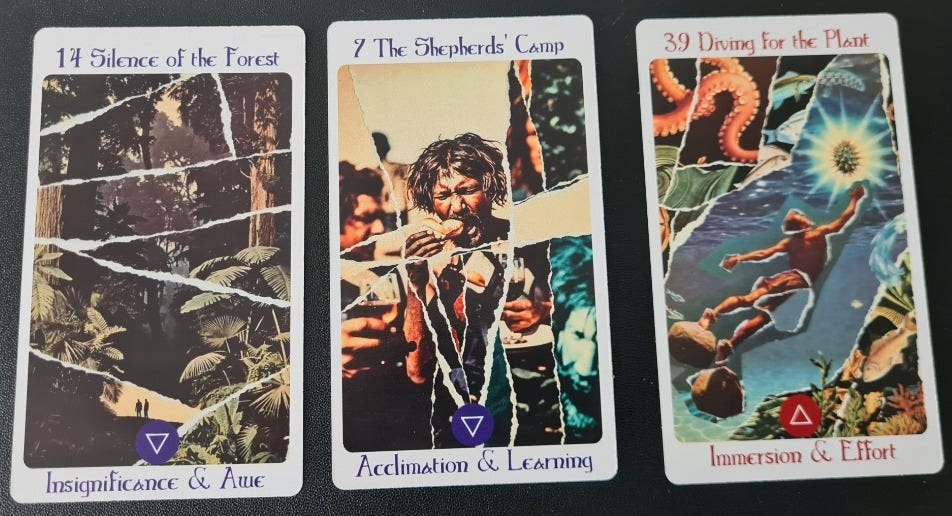
What have you come here to teach me? 14: Silence of the Forest - Insignificance & Awe
There it is. The lesson we probably needed most and asked for least.
The Silence of the Forest card is one of our favourites in the deck - two tiny figures, barely specks, dwarfed by ancient trunks that disappear beyond the top of the frame. Gilgamesh and Enkidu arrive full of bravado, weapons ready, boasts prepared. And the forest simply... doesn’t notice. It was here before them. It will be here after.
The suit here is Water, Albedo - the feeling function - the long, cool bath of the soul. Insignificance and Awe. The deck is telling us, quite clearly, that it has come to work on the ego. To help us find the particular kind of peace that only comes when we stop fighting to be the most important thing in the room - or the story, or the universe.
That’s a profound thing to be offered. And a little humbling to receive, given how much time we’ve spent telling ourselves this project is Terribly Important.
How can we best collaborate? 7: The Shepherds’ Camp - Acclimation & Learning
This card depicts Enkidu, the wild man, learning to eat bread. To drink ale. To live among humanity. It’s not glamorous - it’s the quiet, daily work of integration. Learning a new language, a new set of customs. Becoming fluent in something that was once alien.
This is how the deck wants us to work with it: as students. Not as experts. Not as the people who made it. Come to it humbly, with genuine questions, and let it teach us at its own pace. The Shepherds’ Camp is a threshold card too - it sits between the wild and the city, between raw potential and civilised wisdom. That’s exactly where a good oracle practice lives.
The suit is again Water, Albedo - there’s a theme building here around feeling, patience, receptivity, cleansing and refreshing. The deck is consistent. It is asking us to slow down and immerse ourselves. To acclimatise. To let it become familiar not through mastery but through practice.
What is the potential outcome of our partnership? 39: Diving for the Plant - Immersion & Effort
We love this as a close. The deck opened with a watery scene in the suit of Fire - The Ferryman, Rubedo, the river crossing - and it ends with water and Fire too. Only now, we’ve moved from the surface of the water to the depths beneath.
Gilgamesh ties heavy stones to his feet. He chooses to go down. The plant he seeks - the ‘secret of the gods’ that offers eternal rebirth - can only be found at the bottom, in the dark, among the octopus and the fish, in a world that has no interest in his kingship or his grief.
This is where our collaboration is heading. I won’t be comfortable. It won’t always be easy. The deck is promising, in its quiet way, that it will take us somewhere worth going - but it’s naming the price honestly. Immersion and Effort. A willingness to weigh ourselves down with the questions that matter and go deep.
The suit is Rubedo. Fire. The final stage, where the work becomes physical and irreversible. Where our intuition takes over. Something gets made here. Something gets found.
We came away from this interview excited and slightly chastened — which is, we suspect, exactly the right feeling to carry into a partnership like this. The deck knows what it is. It knows what it can offer. And it has, in its first breath as an oracle rather than a manuscript, already started teaching us.
We’re ready to dive.
The Oracle of Gilgamesh is available now. Visit our Tarot and Oracle Decks page to download the manual, and find the purchase links.
Such an interesting and well thought out deck. Y'all have outdone yourselves!